What Term Was Used by Nazis to Condemn Art

Degenerate Fine art: How the Nazis attacked modernism

"Degenerate Art" is the term Adolf Hitler and his henchmen used to describe works they just did non like. The Nazis are long gone. Much of the art they denounced has survived, and is now on view. Here'southward Erin Moriarty of "48 Hours":
In the cultural uppercase that was Berlin in the early 1930s, art and politics often clashed, with modern artists like George Grosz leading the accuse.
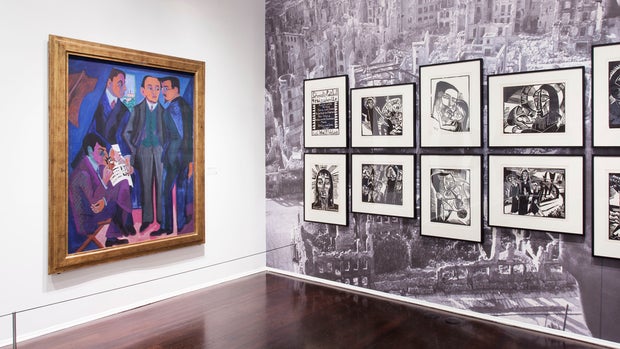
A weapon to lampoon those in power, through political cartoons and graphic, sometimes grotesque, paintings. Grosz even dared to caricature lampoon Adolf Hitler.
"George Grosz poked fun at most everyone, merely especially the Nazis," Petropoulos said. "He threatened the Nazis in a way that -- well, they were never going to forgive him."
Grosz' youngest son, Marty -- now 84 -- recalls a story his father told about Nazi thugs coming to his studio: "They're banging on the door: 'Where is that pig Grosz? Nosotros want him. We'll have intendance of him.' And [Grosz] said, 'Oh gee, I'thou sorry, he's non here. I'1000 merely the guy who cleans upwards.' They believed him! And he got out of it that way."
So information technology'due south no surprise that when Adolph Hitler decided to wage war against mod art, George Grosz became enemy number 1.
His art -- and the works of other contemporary artists, including Paul Klee, Otto Dix, Max Beckmann, Ernst Kirchner, Wassily Kandinsky and others -- were denounced, confiscated from museums, and so put on public display every bit examples of "Degenerate Art."
The exhibit, Petropoulos said, was clearly "very ideological. It was a fashion of articulating the Nazi worldview."
A worldview that saw modern fine art as vulgar and a threat to the German identity.
The original Degenerate Fine art show opened in Munich on July 19, 1937, and was seen past an estimated two million Germans.
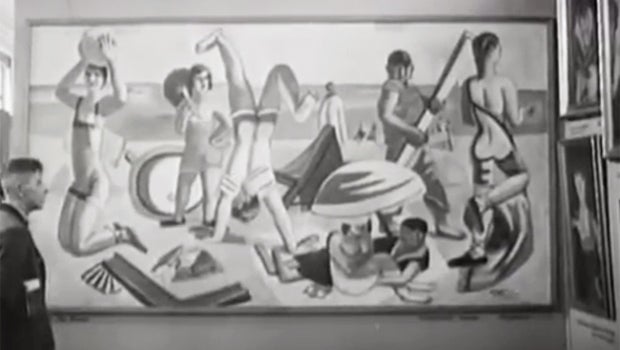
At present some of that fine art has been brought together over again, at the Neue Galerie in New York City.
"Information technology is like a condensed form of what was the historical moment in Munich in the summer of 1937," said the exhibition's curator, professor Olaf Peters.
What makes this new showroom so unusual is that, for the beginning fourth dimension, both the condemned art and art sanctioned by the Nazi Party are on brandish, next.
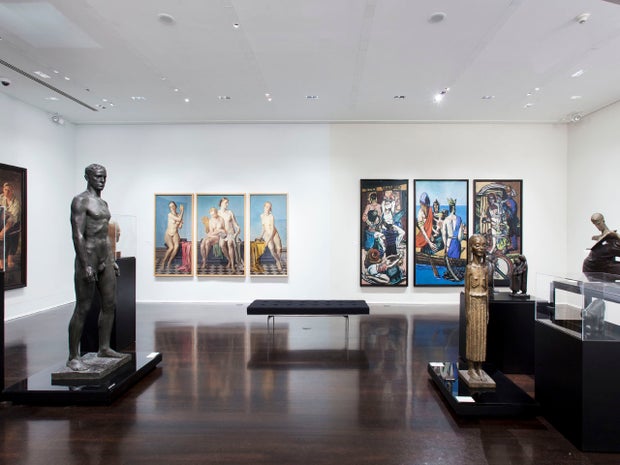
Even artists who were members of the Nazi Party, like Emil Nolde, weren't spared.
In the case of Nolde's painting of a young girl, explained Peters, what was considered degenerate was "the intense color. Information technology is more the portrait of a daughter, not showing us the accurate physiognomy of a girl, but more interpreting her by color."
Too considered to have a "negative influence": A painting of cows, which "in the optics of the Nazis, was sort of ridiculing what was going on," said Peters.
But it's non difficult at all to recognize the sanctioned art, highlighting the virtues of the German people in a style called romantic realism.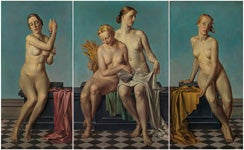
One painting -- Adolf Ziegler's triptych of Aryan women, titled "The 4 Elements" -- was personally bought by Adolf Hitler, said Peters. "And it was placed over his fireplace in the Fuhrer's edifice in Munich. So really the history of the painting is direct linked to the history of Adolf Hitler and what he appreciated in terms of style and image of a woman."
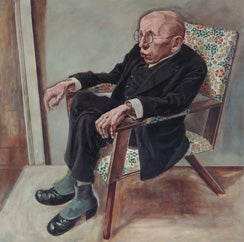
Compare it to George Grosz'south highly realistic portraits, warts and all.
By 1937, Grosz had already packed upward his family and moved to the The states -- Marty Grosz said his begetter had been threatened. And of the Degenerate Art show, Grosz told Moriarty, "I do know that he was kind of depressed near the whole affair."
Grosz, like well-nigh of the degenerate artists, was non Jewish. "Yous didn't have to be Jewish to be disliked by the Nazis," Marty Grosz said. "He was an enemy of the country. And that meant he lost his citizenship, his High german citizenship. He lost his bank account. They garnished, they took everything."
He got a job teaching at the Art Students League in New York, and also worked equally an illustrator.
"He wanted to go American in the worst way," Marty Grosz laughed. "He said, 'If I am going to go to America, I'm going to go an American!'"
As for the other denounced artists? Their self-portraits tell the story: Oskar Kokoschka was defiant; Ernst Kirchner, devastated -- he committed suicide in 1938.
Much of the denounced art was later simply sold off by the Nazis, lost, or even destroyed -- leading them on a path to fifty-fifty greater atrocities, says professor Petropulous.
"I don't think ane can split up the Nazis' fine art policies, their campaign against Degenerate Art and their plundering programs later, from the ideological, the genocidal project," he said.
George Grosz died in 1959. He was never quite able to recapture his place in the world of modern art, but his son Marty says his legacy endures.
"I'1000 proud of him, that he was considered a bad person by Hitler. In a sense it'southward a badge of honor."
For more info:
- "Degenerate Fine art: The Assail on Modernistic Fine art in Nazi Germany, 1937" at the Neue Galerie, New York Urban center (through June 30, 2014)
- Catalogue: "Degenerate Art: The Attack on Modern Art in Nazi Germany, 1937" (Prestel Verlag)
- neuegalerie.org
- Follow Neue Galerie on Twitter and Facebook
- Jonathan Petropoulos, Claremont McKenna College, Claremont, Calif.
- Olaf Peters, Martin-Luther-Academy Halle-Wittenberg
Thanks for reading CBS NEWS.
Create your complimentary business relationship or log in
for more features.
Source: https://www.cbsnews.com/news/degenerate-art-how-the-nazis-attacked-modernism/
0 Response to "What Term Was Used by Nazis to Condemn Art"
Post a Comment