what was frederick the greats significance to the renaissance
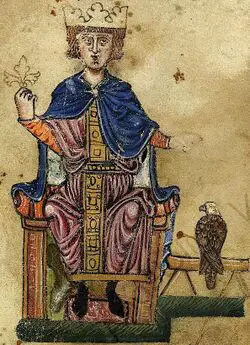
Contemporary drawing of Frederick 2
Frederick II, (26 Dec 1194 – 13 December 1250) Holy Roman Emperor and King of Sicily was one of the about remarkable monarchs of the Middle Ages and indeed in the unabridged history of Europe. He was the ruler of all Federal republic of germany and all of Southern Italy. He was one of the almost powerful men in the Middle ages, and he attempted to change the political organisation of Medieval Europe. He had many ambitious political plans, but they all failed. In many ways, Frederick II can be considered a remarkable failure, only he had a decisive influence on the development of the Renaissance.
Frederick II tin can exist viewed every bit the offset 'Renaissance Prince.'' He was a remarkable graphic symbol, and due to his many accomplishments, he was normally known as 'Stupor Mundi'' or the 'Wonder of the World.''[1] The large question is what influence did Frederick Ii had on the Italian Renaissance, and what did he reach through his cultural patronage? Ultimately, his secular and rational outlook helped shape the Renaissance.
Groundwork
In 1196, Henry VI Hohenstaufen secured the election of his infant son equally Holy Roman Emperor. However, the German nobles rebelled, and Frederick was raised in Sicily. His mother secured the Crown of Sicily, a large kingdom that included Sicily and all Southern Italy. Frederick was king in proper name, and it was only when he gained manhood that he really ruled his kingdom. Afterwards the defeat of his rival in France, Frederick was crowned as Holy Roman Emperor.[2] Nevertheless, he resided in Sicily, and he proved to be a shrewd and capable ruler. He managed to pacify the isle, and he was a tolerant ruler. He was greatly interested in other cultures and treated the Christian, Jewish, and Muslim inhabitants of his kingdom equally. Soon his relationship with the Pope deteriorated as he broke a promise to separate southern Italia from his kingdom in Sicily.
Frederick ruled Germany through a regent, and he ruled all his many lands from Palermo, Sicily[iii]. He created a mod state in his kingdom and transported rebellious Muslim inhabitants to the mainland. Information technology was expected that equally the almost powerful monarch in Christendom, he would go on a crusade and effort to reclaim the Holy Land for the Christians. When he was unable to proceed Crusade, he was excommunicated by the Pope. At this time, he began a conflict with the Northern Italian Metropolis-States, which was to final until his death. Nevertheless excommunicated, the Emperor went on crusade and entered into negotiations with the Fatimid Sultan, and he secured a diplomatic insurrection. He was able to proceeds Jerusalem and Bethlehem through diplomacy, and he subsequently crowned himself Male monarch of Jerusalem.[four]
Shortly he was involved in a brutal war with the League of Italian States (The Lombard League). Some cities sided with the Emperor, and a cruel war raged through Italia until Frederick'southward death. Frederick sought to make himself the undisputed chief of Italia and too to subject Pope to his will. At the same time, he fought a ceremonious war in his German language lands.[v] The wars drained Frederick'south resources, and he was forced to compromise. He agreed to make concessions to the High german nobles, which greatly reduced the power of the Emperor in Deutschland. Frederick'due south son rose in revolt confronting this settlement, by he was shortly defeated. In 1236 Frederick, waged war against the Lombard cities. With some success, and he was on the verge of victory, the Pope intervened. Pope Gregory IX did non desire an Italy dominated by Frederick. The Emperor responded by seizing most of the Papal States.
Gregory Ix died, and Frederick tried to negotiate with his successor after he had suffered a series of defeats such as at the Siege of Parma. However, the war once more turned in Frederick's favor, and he was on the verge of full victory when he died of dysentery in his dearest Sicily. Presently after his death, his empire fell apart. In Germany, the 'Great Interregnum' began when there was no Emperor for several decades. Hohenstaufen was to sit on the Throne of the Holy Roman Emperor, once again. Later a French noble supported by the Pope conquered the Kingdom of Sicily and executed Frederick's son, Manfred. The Hohenstaufen Dynasty was at an end.[six] Frederick 2 was such a remarkable character that many people expected him to return from the dead and saw him in messianic terms.[7]
Frederick 2' Courtroom at Palermo
Frederick was a tolerant ruler, and he was fascinated by different cultures and the exotic. He liked to fill his courtroom with learned men and ar sts. At present previously, royal courts had patronized poets but non to the extent of Frederick Ii. The Emperor sponsored many artists and poets but also patronized scientists such as astronomers. Frederick too showed an interest in exotic animals and had his own zoo. The Emperor'due south Court became a model for Renaissance Princes. Frederick believed in the power of culture and that a prince's duty was to promote and protect the arts and men of learning. This involved commissioning works and supporting them financially. The case of Frederick II Court in Palermo and his example of patronage was to profoundly influenced to influence many leaders in Italia greatly to emulate the Courtroom of Fredrick in Italy, and many followed his case, and this meant that many artists and writers had generous patrons, and this was to prove to be a crucial factor in the Renaissance.[8]
Frederick Ii and Reason

Gimmicky bust of Frederick II
The Renaissance is often seen equally an era where reason prevailed and as a divergence from Middle Ages. Frederick Two was a rationalist, and unlike his contemporaries, he did not defer to tradition but sought to utilize reason to every aspect of his land and his policies.[9] Frederick II used rational principles to create i of Europe's first centralized states, since the Fall of the Roman Empire. He demonstrated to succeeding generations that reason could be used to build a state and to perfect it. This greatly influenced the 'land as a piece of work of art' and used reason rather than tradition to mold and administer their domain.[10]
Frederick'southward rationality is best seen in his laws. He developed new and progressive law codes for both his kingdom of Sicily and his German realms. He based his new laws on reason and did non believe that tradition or custom had any part in legal reasoning and the legal code. For case, he outlawed trial by combat as a manner of determining a police case.[11] He declared information technology to be irrational. Frederick also issued directives that can be seen as very rational and progressive. He ordered physicians (doctors) be to distinguished from apothecaries (chemists), and none could practice both occupations. Frederick encouraged scientific investigation at his court. He himself wrote a book on falconry anatomy and behavior. He likewise encouraged the investigation of the natural phenomenon at his courtroom. Frederick fabricated the investigation of nature popular among the learned. This was to inspire others to begin to investigate nature, and the 're-discovery of nature is one of the preoccupations of the Renaissance.[12]

This new interest in nature was to lead to the growth in education and did much to lay the foundations for modern science. However, not all Frederick'south experiments are laudable. He also ordered experiments to be carried out on human beings. One example is the notorious language impecuniousness experiment where young infants were raised without human contact to see what language they would speak. Still, none ever did speak, and they all died. Frederick believed that educational activity was extremely beneficial, and this idea, quite novel, proved influential in the Renaissance. The Emperor founded the University of Naples, and it was to become one of the leading centers of learning in Europe. Many leading humanists who contributed to the Renaissance studied at Frederick's university.
Frederick Two and the Muslim World
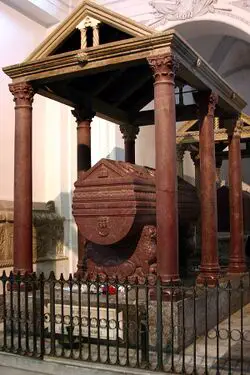
Sarchophugus of Frederick Two in Palermo
Frederick Ii was widely defendant of being a heretic or even of being the Anti-Christ, mostly by supporters my, the Pope. In truth, Frederick was a devout Christian, and although excommunicated, he died in a monk'due south habit. He certainly was an unorthodox Christian and was interested in other cultures. His Kingdom of Sicily was a multicultural i, where, Italian, Jew, Norman, and Muslim lived as neighbors because of its recent turbulent history. Frederick was extremely tolerant for his times, and this was undoubtedly a necessity in his multicultural kingdom.[13]
However, he was also genuinely interested in Muslim and Jewish culture. As a effect, his Courtroom in Palermo was a cosmopolitan one and shortly became the most cultured in Europe and the Middle East. Frederick'south credence of different cultures was to have a real touch on on the development o the Renaissance. The Muslim World, unlike Europe, was very much interested in ancient learning, particularly that of the Greeks. Muslim scribes and scholars had washed much to preserve the learning of the Classical World. Frederick 2 organized for many Greek manuscripts to exist brought to his court in Palermo. He commissioned them to exist translated by Jewish and Muslim translators, and as a result. Equally new or improved versions of peachy works by Greek philosophers, mathematicians, scientists, and others these works did much to promote an interest in the Classical World and indeed efforts to emulate the Roman and the Greek world, 1 of the main characteristics of the Renaissance.[xiv]
Frederick 2 and Literature and Language
Possibly Frederick's greatest contribution to the evolution of the Renaissance was in literature and the Italian Language. Frederick could speak vi languages, and he loved verse. He was himself a poet and appreciated the company of poets. At his courtroom, a group of poets known as the Sicilian School flourished. This grouping of poets, possibly influenced past Standard arabic and Provencal exampled new styles and ways of expressing their themes.[15] The poets of the Sicilian Schools extolled a new kind of poesy based on their own personal experiences and above all, they helped to perfect the love lyric.
The School was also very important in the development of the sonnet, a form that was to be used by many of the grcriticalf the Renaissance in Italy and, indeed, elsewhere. They were the start to apply an Italian dialect as a literary linguistic communication and did non seek to write in Latin. This was to have a great influence on Renaissance literature and helhe evolution of an Italian literary linguistic communication.[xvi] The poets were to hadevelopce on the evolution of the Italian literary language, the language that was used by Dante, Petrarch, Boccaccio, and others. Many of these writers freely best-selling thewhichcilian Schoolhouse. Dante acknowledged Frederick Two's role in the evolution of a literary linguistic communication and Italian poesy even though he consigned the Emperor to hell in his great poem, the Ideveloping, The Inferno, trans by Mark Musa (Penguin, London, 1990), p. 115</ref>
Decision
Frederick 2 was a remarkable man, and he dominated his era. He was an international effigy, and if he had succeeded in his plans, he could accept changed European history. His constant achievement was peradventure in the field of culture. He patronized artists and writers, and this was emulated by later rulers. This was to be very of import in the Renaissance. The Emperor also facilitated the translation and dissemination of many works from the Greeks, and they too were influential. Frederick 2 valued reason in politics, his administration, and the law, he also encouraged empirical investigation, and this was to have inspired, a literary patron, he made a lasting impression on the evolution of the Renaissance. His patronage of the Sicilian School was to alter the lay the foundations for Renaissance literature. The office of Frederick 2 should not be overstated, but nonetheless, he helped to create an environment in Italy that helped promote the Renaissance.
===Reference
- ↑ Kantorowicz, Ernst. Frederick the Second, 1194–1250 (London, Longman, 1931), p. 167
- ↑ Abulafia, David. Frederick Two. A Medieval Emperor (Penguin Press, London, 1988), p. 78
- ↑ Abulafia, p. 113
- ↑ Smith, Thomas W. "Between ii kings: Pope Honorius Three and the seizure of the Kingdom of Jerusalem past Frederick Two in 1225." Journal of Medieval History 41 #1 (2015): 41-59
- ↑ Abulafia, p. 117
- ↑ Abulafia, p. 117
- ↑ Cohn, Norman, Millenarianism in the Middle Ages (Penguin, London, 1980), p 167
- ↑ Abulafia, p. 119
- ↑ Abulafia, p. 119
- ↑ Burkhardt, Jacob, The Culture of the Renaissance in Italy (Penguin, London, 1992), p. 167
- ↑ Burkhardt, p. 117
- ↑ Burkhardt, p. 119
- ↑ Kantorowicz, p. 176
- ↑ Kantorowicz, p. 178
- ↑ G. Marrone, P. Puppa, and 50. Somigli, (eds). Encyclopaedia of Italian literary studies, Book I (Longman, Uk, 2007), p782
- ↑ Burckhardt, p. 115
Source: https://dailyhistory.org/What_was_the_influence_of_Emperor_Frederick_II_on_the_Italian_Renaissance%3F
0 Response to "what was frederick the greats significance to the renaissance"
Post a Comment